

People are not trying to hide something suspicious. They are tired of uploading their passport to watch a football match.
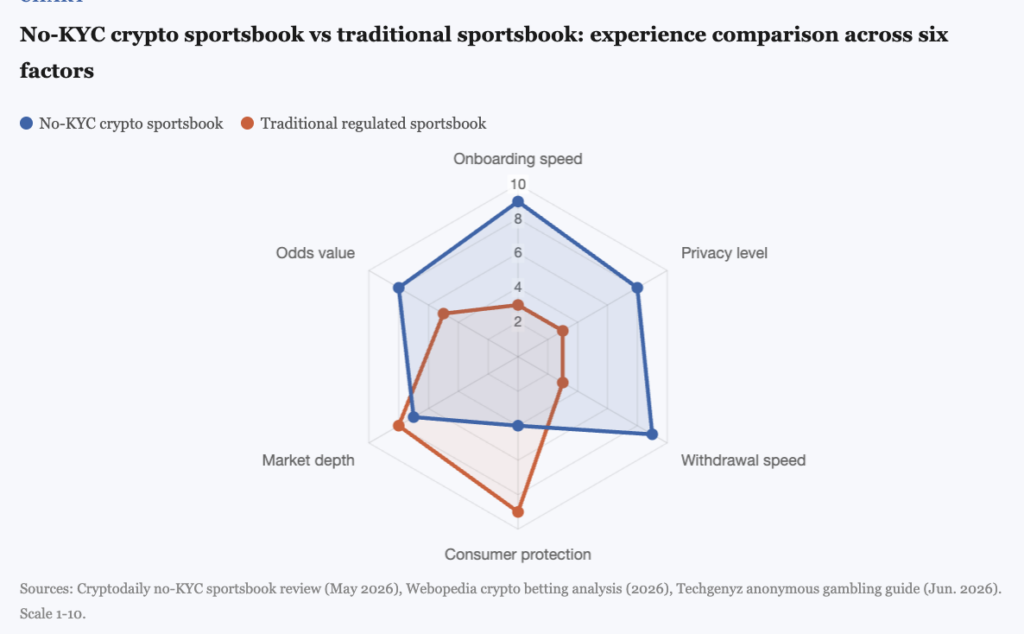
In early June, Sofia wanted to bet on a World Cup match. She chose a crypto sportsbook that she had read about in a forum. The sign-up process asked for an email address and a password. That was it. She connected a wallet, deposited some USDT, and placed her first bet within about six minutes of visiting the site—no government ID. There is no utility bill. She didn’t take a selfie with her passport. You won’t have to wait two days for the verification email that never arrives. The year before, she had used a traditional sportsbook where the Know Your Customer (KYC) process took four days, required her to resubmit her documents twice because the photo quality was not good enough, and ended with a customer service chat where someone asked her to explain the source of the 80 dollars she was depositing. She did not find the experience reassuring. She was offended by it. The no-KYC platform felt different, not because she was trying to hide anything, but because it treated her like an adult who had decided to spend her own money on a legal activity.
The reason for the growth of anonymous betting platforms ahead of the 2026 World Cup is that people feel like customers rather than having to follow rules. This has very little to do with cryptocurrency ideology or anything technically complicated.
What changed in people’s expectations about online privacy
Ten years ago, most people thought that when you signed up for an online service, you were giving them your personal information. That was just how the internet worked. But by 2026, this idea had changed a lot. This was because of major data breaches at well-known companies, more people becoming aware of how their personal data is used and sold, and people thinking differently about what they give to the platforms they use. A lot of people, especially younger bettors, think it’s too much to expect a sports betting site to know your home address, have a copy of your passport, and be able to check your income before letting you deposit forty dollars.
Crypto sportsbooks that don’t require KYC didn’t create this expectation. They responded to it. The platforms that focused on wallet-based accounts and simple registration grew quickly. This wasn’t because they marketed anonymity aggressively, but because they offered a betting experience that matched what many people wanted.
What no KYC actually delivers and where the limits are
The truth is that no KYC at a sportsbook means your name and documents are not held by that operator, not that you are invisible to everyone. Every time money is sent via blockchain, it is recorded and linked to the recipient’s address. If you bought your crypto on an exchange using your real identity and sent it directly to a betting site, a tool that can analyse blockchain data could trace that path if someone specifically wanted to. Most people who bet on football matches do so in secret. The privacy benefits are real, even if you can’t be completely anonymous. Your bank doesn’t see the transaction. Your employer won’t see any gambling transactions on your bank statement. The sportsbook does not have a file on you that could be leaked in a data breach or handed to a third party. These are important protections for regular bettors, even if they don’t offer the complete anonymity that some marketing claims suggest.
The anonymous betting world cup 2026 audience is not a single type of person. It includes people in countries where online betting is not clearly legal and local platforms are unavailable. It also includes users who have had bad experiences with traditional sportsbook KYC processes, bettors who are privacy-conscious about their online activity in general, and casual fans who want to place a few bets during the tournament without creating a full account with a regulated operator. Their reasons may differ, but the common expectation is the same: lighter registration requirements and fewer barriers before placing a bet.
Frequently asked questions about anonymous betting at World Cup 2026
What does anonymous betting actually mean at the World Cup 2026?
This means using a crypto sportsbook that does not ask for your ID to register, deposit, or place a bet. All you need to do is sign up with an email address, connect a wallet, and start placing bets. The operator does not hold your name and passport. Blockchain transactions are still publicly recorded, but they are linked to wallet addresses rather than your identity.
Why are so many people choosing sportsbooks that don’t require KYC for the World Cup?
This is mostly because the usual KYC process at regulated sportsbooks is slow and frustrating. Uploading documents, waiting for them to be checked, resubmitting photos, and explaining where the deposit came from. No-KYC platforms skip all of that and let you start betting within minutes. The privacy benefits are real, but the main reason people switch is because of the easy sign-up process.
Is no-KYC betting completely anonymous?
Not completely. Any blockchain transaction is public information. If you bought crypto on an exchange using your real identity and sent it directly to the sportsbook, a tool that can trace crypto transactions could link the two. The operator does not hold your documents, and your bank does not see the transaction. This provides meaningful privacy, even if it is not total invisibility.
Are sportsbooks that don’t require KYC verification safe to use for World Cup betting?
Licensed ones are more reliable than unlicensed ones. Make sure the gambling site has a real licence and read the terms and conditions carefully. Even though you don’t have to verify your identity when you sign up, this doesn’t mean there are no checks at all. Many platforms require identity verification for larger withdrawals, even if they say they don’t check your ID when you sign up.