
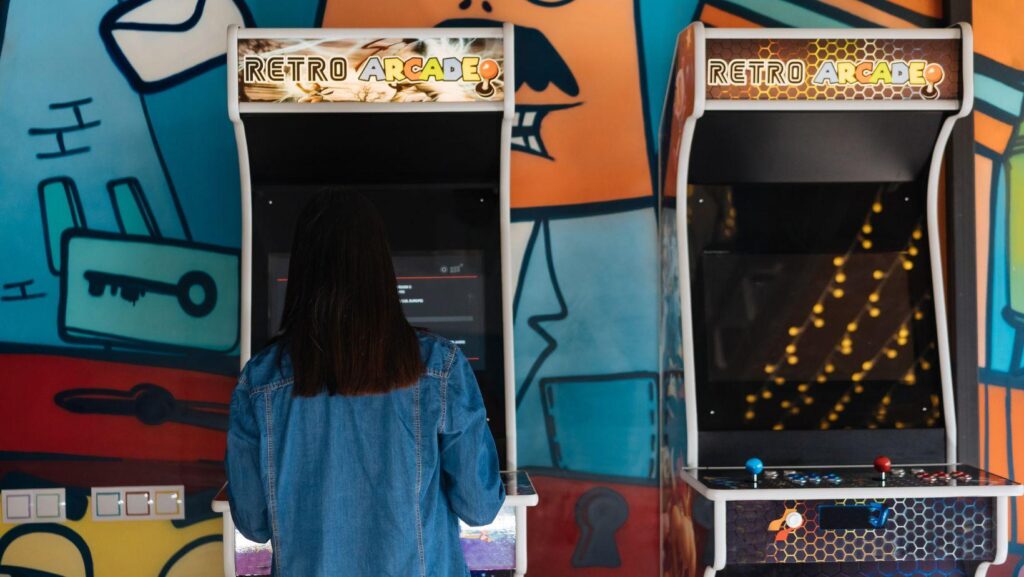
The Short Session Has Always Been Around
Long before 'mobile-first' was a design principle, arcade cabinets had already solved the short-session problem. A quarter bought you a few minutes, the game had to hook you fast, and the whole design — from Pac-Man's instantly readable maze to Galaga's escalating wave structure — was built around delivering a complete, satisfying loop in a tight window. That constraint produced some of gaming's most enduring design patterns.
It's worth tracing a direct line from that arcade design philosophy to today's instant-play, browser-based games, because the underlying constraint — hook the player fast, deliver a complete loop quickly, make them want another go — hasn't changed even though the hardware has completely turned over.
The venues changed just as much as the games did. Arcades were social spaces by necessity — you played where the cabinet was, often with a line of other players waiting behind you, which shaped everything from difficulty curves to how forgiving a game could afford to be. Instant-play titles today are almost entirely solitary by default, played on a personal device with no queue and no audience. That shift removed a natural social pacing mechanism — the unspoken pressure of a line behind you — that arcade design used to lean on without ever having to build it in deliberately.
What Instant-Play Kept From the Arcade Era
Modern instant-play titles, including the slot and casino games hosted on platforms like spin samurai casino, inherit quite a bit from that arcade lineage: no install step (the coin-op equivalent of just walking up and playing), a round structured to complete in seconds, and immediate, legible feedback on the outcome. The 'one more go' pull that made arcade cabinets so effective at the quarter level is the same mechanic doing the work in a modern instant-play round — a tight, complete loop that resolves fast enough to invite another attempt.
Where the two eras genuinely differ is in accessibility of that loop. An arcade required a physical trip and a pocket full of coins, which was its own natural brake on a session. Instant-play removes that friction entirely, which is a real design achievement but also changes the risk profile of the format — there's no longer a walk to the arcade acting as a built-in pause.
It's worth sitting with that trade-off for a moment rather than rushing past it. Every bit of friction removed from a design makes the product better at the thing it's trying to do, but not every piece of friction was purely accidental — some of it was quietly doing useful work, and a good designer replaces it deliberately rather than simply celebrating its removal.
What Today's Designers Can Learn From Coin-Op Constraints
Arcade-era designers worked under brutal constraints — a few kilobytes of memory, a single screen, and a hard requirement to be understood by a stranger within seconds of walking up. Those constraints, rather than limiting creativity, tend to be exactly what produced the era's most enduring design lessons: readability at a glance, an immediately clear objective, and a feedback loop so tight there was never any doubt what had just happened on screen.
That discipline is worth revisiting for anyone designing a modern app, regardless of genre. It's easy, with essentially unlimited screen space and processing power available today, to let an interface sprawl past the point of instant clarity. The arcade cabinet's forced simplicity is a useful check on that tendency — a reminder that a design constraint, chosen deliberately rather than imposed by old hardware, often produces a clearer and more satisfying product than having no constraints at all.
Designing the Brake Back In
That missing friction is worth replacing deliberately rather than leaving it to chance, and it's genuinely encouraging that most well-built instant-play platforms now do exactly that: visible session timers, deposit caps, and reminders that function as a digital version of running out of quarters. If you're spending time in this category, actually setting those limits before a session starts — rather than treating them as optional settings buried in a menu — restores the natural brake the arcade era had built in physically.
It's a neat example of a design problem coming full circle: the arcade's coin slot was an accidental responsible-gaming feature, and modern instant-play design is now rebuilding that same function on purpose, as a first-class part of the interface rather than an afterthought.
For anyone who grew up feeding coins into a cabinet, that's a genuinely reassuring evolution — the constraint that used to come from an empty pocket now comes from a deliberate setting, which is arguably a more honest and more consistent brake than luck ever was.